

TV poker, besides good hands, always needed something more pressure, timing, personality, money on the table, and one decision that makes people lean in. A hand can be technically brilliant and still disappear from memory. Another can be emotional, or unusual, and somehow become part of poker history forever.
Some hands were worth millions. Some were tournament hands where the money jump was bigger than the pot itself. Some became famous because of the quote but together, they show why poker worked so well on TV: viewers could see the cards, understand the danger, and watch famous players make impossible decisions in real time.
10. Matt Affleck vs Jonathan Duhamel
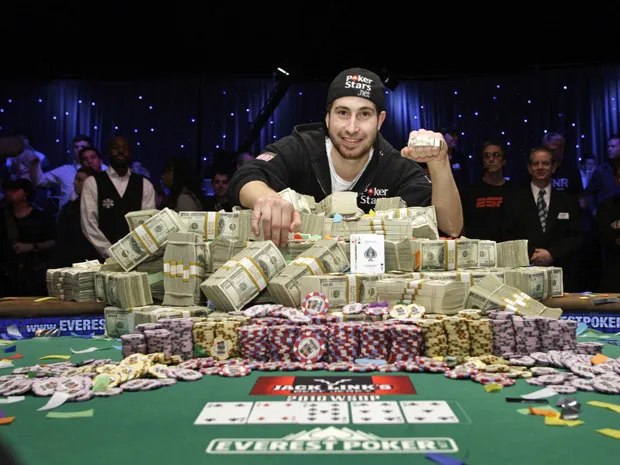
One of the most painful WSOP hands came in the 2010 Main Event, when Matt Affleck and Jonathan Duhamel played a pot that changed the course of the tournament. It wasn’t a final table hand, but it felt like one.
Affleck had the best possible starting hand: two aces. Duhamel started with two jacks, which is also strong, but clearly behind two aces.
The pot got bigger before the first three community cards were dealt, and it kept building after that. By the time the fourth card came, Affleck was in a great position to win a huge pot and become one of the biggest stacks left in the Main Event.
Then the river brought the eight that completed Duhamel’s straight. Affleck walked away crushed, and the ESPN cameras caught the full emotional cost of it.
PokerNews described it as “one of the most memorable hands in the history of the World Series of Poker Main Event”. Poker moments like this also explain why famous TV hands still connect with people who now play online poker on Stake and other modern platforms. The format has changed, but the feeling is the same: a strong starting hand can look safe, the pot can grow quickly, and one final card can change everything.
In the end, Jonathan Duhamel won $8,944,310 which made Affleck’s loss even more painful.
9. Tony G vs Ralph Perry
Not every famous poker hand is remembered for perfect strategy. Tony G against Ralph Perry at the 2006 Intercontinental Poker Championship became popular as one of the loudest trash talk moments on poker TV ever.
Tony G limped with A♠2♠. Ralph Perry, representing Russia, raised in the big blind with K♣J♠. Tony G moved all in, Perry called, and the board ran out 2♣3♦10♠7♦6♣. Tony G’s pair of deuces held. Then the hand turned into a clip that poker fans have replayed for years.
“Come on Russian, get out! It’s time to go!” Tony G shouted. Then came the line that made the hand last: “Your career is finished. You are gone. On your bike!” PokerNews lists the moment among Tony G’s most memorable hands, while the tournament itself featured 21 players at the Palms in Las Vegas.
Tony G’s behavior was over the top, but it also showed why poker television in the mid 2000s became so easy to sell. The cards were important, but personalities carried the tournaments.
8. Scotty Nguyen vs Kevin McBride
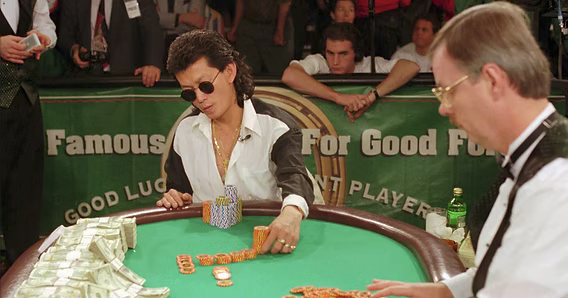
The final hand of the 1998 WSOP Main Event gave poker one of its most famous quotes. Scotty Nguyen and Kevin McBride reached heads-up play with $1 million for first place and $687,500 for second.
The board ended up showing 9-9-8-8-8, meaning any player could play the board for a full house. Nguyen, however, had J-9, giving him a better full house. McBride was considering the call when Nguyen delivered the line: “You call, it’s gonna be all over, baby.”
McBride called and said he played the board. Nguyen showed the better hand and became world champion.
That sentence is still quoted because it was a pure poker theater. It sounded casual, but it was also a perfect representation of poker pressure.
7. Brad Booth vs Phil Ivey
Brad Booth’s bluff against Phil Ivey on High Stakes Poker is one of the great examples of a player using real cash as a weapon. Booth had 4-2. Ivey had pocket kings. On the flop, Booth made a huge overbet, pushing $300,000 in cash into the middle and forcing Ivey to make a decision with one of the strongest overpairs possible.
Ivey folded.
That’s why the hand became so famous. Bluffing an ordinary player is one thing. Bluffing Phil Ivey off kings on TV is different. Booth later said, “I had really dialed it in and put him on kings,” adding that he knew Ivey was likely to fold in that spot.
The hand also captured what made High Stakes Poker different from other tournaments. The chips were real money, not tournament units. The show’s format was a cash game, with minimum buy-ins reaching six figures and some players buying in for much more. That made for a true TV spectacle.
6. Gus Hansen vs Daniel Negreanu
Gus Hansen against Daniel Negreanu is one of the cleanest TV poker coolers ever shown. Hansen had pocket fives. Negreanu had pocket sixes. The flop gave both players a set, putting Negreanu way ahead. Then the turn gave Hansen quad fives, while Negreanu improved to a full house.
The pot became enormous. Hansen eventually won $575,700, and the hand was the largest pot on High Stakes Poker before the show moved into even bigger buy in games. The numbers are still wild: on the flop, Hansen was in terrible shape; after the turn, Negreanu was the one almost drawing dead.
In this game there was no huge bluff, no speech, no controversy. It was simply the kind of setup poker players fear. A full house is usually a dream hand. Against quads, it becomes a trap. Negreanu’s reaction helped sell the moment because he seemed to understand that something was wrong, even though folding a full house in that spot was close to impossible.
5. Tom Dwan vs Barry Greenstein
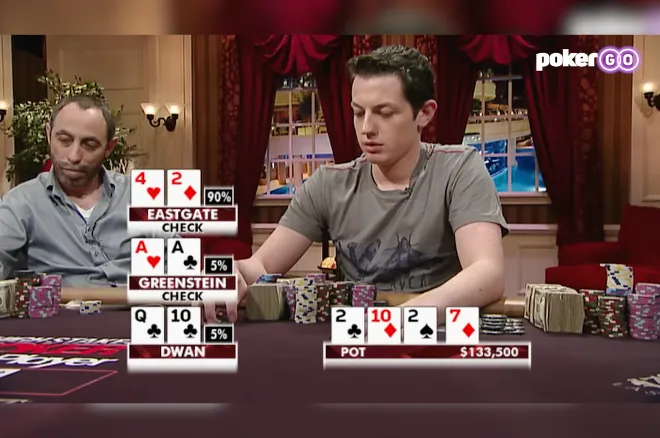
Tom Dwan’s $919,600 pot against Barry Greenstein became one of the defining hands of the original High Stakes Poker era. Greenstein had A-A. Dwan had K-Q of spades. Peter Eastgate was also in the hand early, but the real fight became Dwan versus Greenstein after the flop came with a queen and two spades.
The money went in with Dwan holding top pair and a flush draw against Greenstein’s aces. It was close to a coin flip once all the chips were committed. Greenstein wanted to run it once, and Dwan agreed. The turn and river gave Dwan the winner, and he dragged a pot just short of $1 million.
The hand is still remembered because Dwan looked fearless in a way that changed TV poker. He wasn’t from the old school live poker group. He represented the online generation, and hands like this made him look ready to battle anyone. It wasn’t just the amount. It was the image of Dwan sitting there against a respected veteran, refusing to back down, and winning one of the biggest pots ever shown.
4. Robbi Jade Lew vs Garrett Adelstein The J-4 hand between Robbi Jade Lew and Garrett Adelstein on Hustler Casino Live became one of the most controversial poker hands. It happened in 2022, during a high stakes cash game in Gardena, California. Lew called Adelstein’s huge all in bet with jack high, holding J-4, and won a pot reported at around $269,000 after the board was run twice.
The poker world exploded almost immediately. Adelstein suspected something was wrong. Lew denied cheating. The hand became bigger than the pot because it pulled in questions about RFID cards, livestream security, production rooms, player behavior, and how much trust viewers can place in modern poker broadcasts. The later investigation found no evidence of cheating, although it did identify security vulnerabilities and led to tighter rules around phones, personal items, and access to the stage. The Los Angeles Times reported that the production company spent more than $100,000 on the investigation and reviewed video, security footage, the shuffler, and the table’s RFID system.
Whether people view the call as genius, confusion, misread information, or something else, the hand is part of poker history now. It showed that in the livestream era, one strange call can become bigger than an old ESPN final table.
3. Tom Dwan vs Wesley Fei
Tom Dwan appears again because no player is more tied to huge televised cash-game pots. In 2023, on Hustler Casino Live’s Million Dollar Game, Dwan played Wesley Fei in a pot worth about $3.1 million. Sports Illustrated reported it as the largest pot in televised poker history, with Dwan winning the hand holding pocket queens.
The hand had everything modern poker viewers expect: massive stacks, a livestream audience, a fearless amateur businessman, and a pro who had already been part of poker’s biggest TV moments.
What made it famous was not only the number. Poker has had huge private cash games for decades, but most of them were never shown clearly to the public. This one was broadcast, clipped, debated, and watched by fans who could see the cards. Dwan’s pair of queens had to stand up under pressure while the pot climbed to a number that looked unreal.
2. Johnny Chan vs Erik Seidel
Johnny Chan trapping Erik Seidel in the 1988 WSOP Main Event might be the most cinematic real poker hand ever shown on television. Chan was already the defending champion. Seidel was making his first major Main Event run. There were 167 entrants, and Chan won $700,000 for first while Seidel took $280,000 for second.
The final hand became legendary. Chan flopped a straight. Seidel had the top pair. Chan checked and let Seidel keep believing he might have the best hand. On the river, Seidel moved all in, and Chan called instantly with the winner.
The hand was already famous in poker, but the 1998 film Rounders pushed it into wider culture. PokerNews noted that movie fans often connect the WSOP with that scene, where Chan’s “Eye to the Sky” moment is shown before the final trap closes. Seidel later looked back on that heads up match and said poker was different then: “It was easier to put people on a hand back then.”
1. Chris Moneymaker vs Sammy Farha
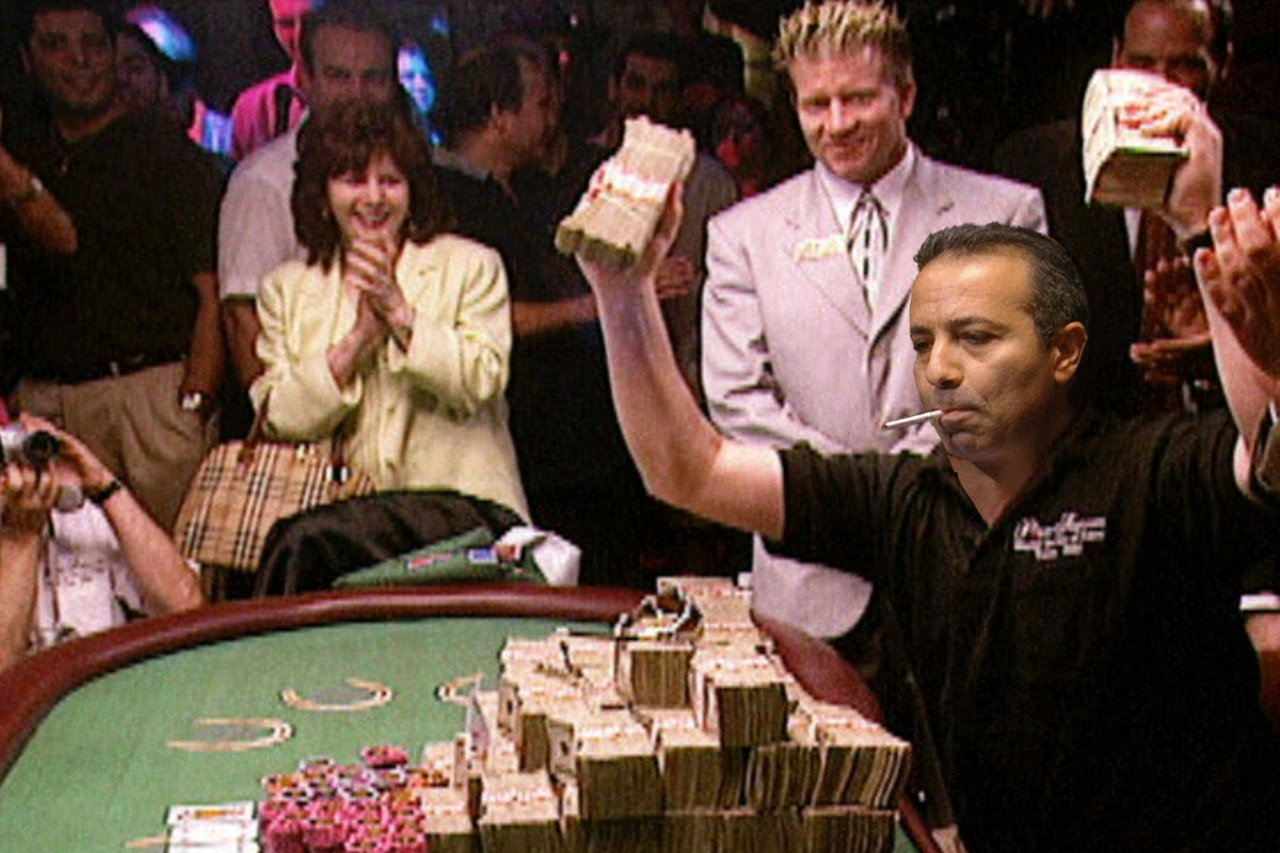
No televised poker hand has a stronger claim to number one than Chris Moneymaker’s bluff against Sammy Farha in the 2003 WSOP Main Event. Moneymaker was an amateur accountant who got into the tournament through an online satellite. Farha was a cool, experienced pro.
The heads up match had $2.5 million for first place and $1.3 million for second.
The hand came heads up. Moneymaker missed his draw and moved all in on the river with king high. Farha had a pair and went deep into thought. If Farha called and won, the match could have swung heavily toward him.
Instead, he folded. ESPN commentator Norman Chad called it “the bluff of the century,” a quote that still follows the hand.
That bluff became the symbol of the poker boom. Moneymaker later won the tournament, beating Farha in the final hand when his two pairs improved to a full house. But the bluff is the hand people remember first because it made the impossible feel possible. A regular player from outside the old poker world sat under the lights, moved all in against a pro, and got him to fold.
That was perfect television. It had risk, character, timing, and a result that changed the business of poker. Online poker grew. ESPN poker broadcasts became must-watch content. Suddenly, millions of people believed they could qualify, sit down, and have their own Moneymaker moment.
Why Poker Fans Still Replay These Hands
The most famous poker hands on TV usually fall into a few clear groups. Some are famous because of money, like Dwan against Wesley or Dwan against Greenstein. Some are famous because of a quote, like Scotty Nguyen or Tony G. Some are famous because of pure poker pain, like Affleck against Duhamel. Others live forever because they changed how people saw the game, like Chan trapping Seidel or Moneymaker bluffing Farha.
The best TV poker hands are easy to retell. You don’t need to explain every detail. One player had aces and lost. One player had a jack high and called. One player said, “On your bike.” One player looked at the ceiling, waited, and snapped off the final bet. One amateur bluffed a pro and helped launch a boom.
That’s why these hands remain famous. Poker is a game of math, but television poker is also about faces, silence, fear, ego, and one card turning a normal pot into an iconic move.


