
Lose a roll, double the next bet, and wait for a win. Or double after a win and see if you can build a short streak. Or keep betting the same amount, regardless of what happened last time. Those are the basic ideas behind Martingale, Paroli, and flat betting.
Each gives you a rule to follow. They can't make the next roll more likely to land in your favor.
Dice is a perfect, simple game for seeing how these systems work. No bonus rounds to untangle or card decisions to learn. You choose a win chance, accept the payout, and get a result.
However, before trying any betting system, answer one question: are you changing your chances, or just changing how much money is riding on the next result?
How Stake Dice Works
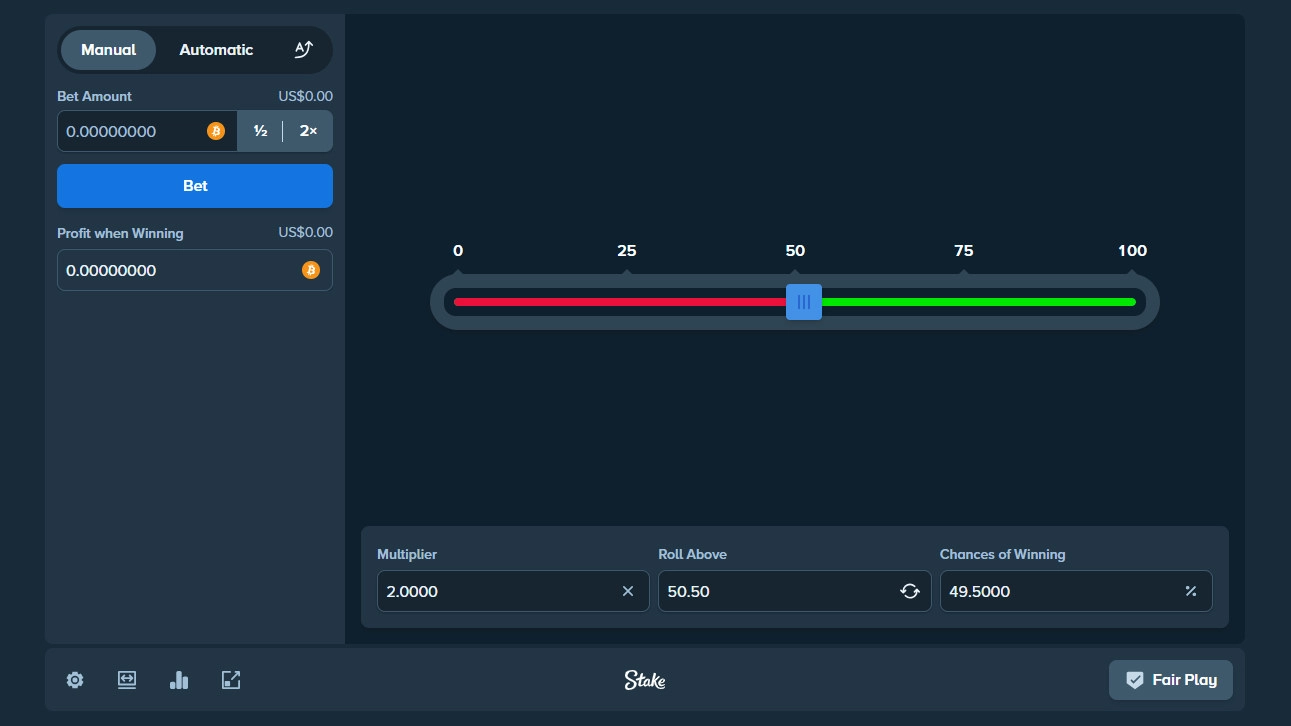
Stake Dice is a roll-over-or-roll-under game, meaning you bet that the result will be higher than your chosen number or lower. You select a target and place a bet. Adjusting the win chance automatically changes the multiplier.
A higher win chance comes with a smaller payout. A lower chance comes with a larger one. Stake lists a 99% return to player, or RTP, equivalent to a 1% house edge.
The multiplier includes your original stake. If a $1 bet wins at 2x, you receive $2 in total. It does not mean $2 profit on top of the stake.
Win Chance and Payout Move Together
Using the stated 99% RTP, the payout is:
Multiplier = 99 / win chance expressed as a percentage.
That gives these examples:
-A 50% win chance corresponds to 1.98x.
-A 49.5% win chance corresponds to 2x.
-A 25% win chance corresponds to 3.96x.
-A 10% win chance corresponds to 9.9x.
A 50% chance and a 2x payout might sound the same, but they aren't. A 50% win chance pays 1.98x, rather than 2x, because of the house edge. So, a winning $1 bet earns $0.98 profit, which can affect some strategies.
What the 1% House Edge Actually Means
Imagine 100 $1 bets on a provably fair Dice game with a 50% win chance and a 1.98x payout. If exactly 50 win and 50 lose, the winning bets return $99 altogether. You wagered $100, so you are $1 short at the end.
Game rounds won’t neatly produce 50 wins every time. You could finish ahead, lose much more than $1, or land somewhere in between. RTP describes the long-run mathematical return, not the amount you should expect every time.
The calculation is: Expected loss = total amount wagered x 1%.
For $500 of total wagers, that gives an expected loss of $5. It doesn’t predict your final balance. Also, total wagers are not the same as your deposit. You might deposit $50 and repeatedly bet money you win back. Your total wagers can pass $500 without another deposit.
That is why you should still account for a small house edge. Reusing the same balance creates more bets, and every additional bet carries that edge.
Martingale Means Doubling Your Bet After a Loss
Martingale is the most appealing system because it suggests doubling the bet after every loss, eventually clearing all previous losses. The standard version starts with a small bet, doubles after every loss, and returns to the starting amount after a win.
At a 2x payout, the bets would look like this: $1, $2, $4, $8, $16, and so on. Suppose you lose the first three bets, costing $7 altogether. The next $8 bet wins. At 2x, it produces $8 profit, recovering the $7 in losses plus $1 in profit.
The calculation works. The problem is paying for the sequence until that win arrives.
A Small Starting Bet Can Become a Large Commitment
After six consecutive losses, the $1 starting bet has already turned into $63 lost. The next required stake is $64. You therefore need $127 available to fund those six losses and place the seventh bet. A $100 budget won’t cut it, even though the opening wager was only $1.
After ten losses, the accumulated loss is $1,023. The next bet would require another $1,024.
Martingale often produces several small wins before a losing run causes a much larger loss. This can make players believe that the system works, when in reality the big loss is just around the corner.
How Likely Is a Losing Run?
At a 2x payout, your win chance is 49.5%, and your loss chance is 50.5%. The probability of losing six times in a row is around 1.66%. This means that the chance of losing your next six rolls is roughly one in 60. If you keep playing, you have more chances of a six-loss streak happening.
Also, five previous losses don’t make the next roll more likely to win. Its chance remains 49.5%. The bet has grown. The chance has not.
Doubling Does Not Work the Same Way at Every Multiplier
A common mistake is applying the same doubling to a payout below 2x. At 1.98x, a winning bet earns net profit equal to 98% of its stake. After six losses totaling $63, a winning $64 bet produces $62.72 profit. The game still finishes $0.28 down.
At a much smaller multiplier, doubling can cause even more loss. A higher win chance gives more frequent wins, but each winning bet pays less.
The Martingale system could work, but you need to consider the money required when recovery takes longer than expected.
Paroli Raises the Bet After a Win
Paroli reverses the direction. Instead of increasing after losses, you increase after wins. A common version doubles after each win, resets after a loss, and ends after three consecutive wins.
At a 2x payout, three bets would look like $1, $2, $4. Win all three and the profits add up to $7. Then the stake returns to $1.
However, a losing streak doesn’t increase the next bet. Each loss resets the bet to the starting stake.
What Happens When the Streak Ends Early?
With an exact 2x payout, the math is simple. If you lose the first $1 bet, the cycle ends $1 down. Win $1, then lose the $2 bet, and the cycle ends $1 down again. The first win earned $1, while the second bet lost $2.
Win the first two bets, then lose $4, and you're still down $1: $3 profit followed by a $4 loss. Three consecutive wins produce $7 profit. Every earlier failure costs $1.
Three Wins Still Have to Happen
At a 49.5% win chance, the probability of three consecutive wins is around 12%. Based on this probability, the average result per round is about −$0.03. That’s a mathematical average across many cycles, not a prediction. It also fits the 1% edge applied to the average amount wagered.
The Paroli system is often called “playing with winnings.” Once a bet pays, those winnings are yours. Putting them into the next wager means risking money you could otherwise keep.
Flat Betting Keeps the Stake the Same
Flat betting means choosing a fixed amount and sticking to it regardless of the previous round's outcome.
If the stake is $1, the next bet stays $1. There’s no recovery ladder and no attempt to increase risk during a winning run. It’s the easiest of these systems to track. You know what each losing roll costs, and your recent results don’t determine the next wager size. That can help with budgeting, but it doesn’t guarantee winning.
The Math Is Easier to Follow
Consider 100 bets of $1 at a 2x payout. If 55 win and 45 lose, the net result is $10 profit. If 45 win and 55 lose, it’s a $10 loss. Exactly 50 wins produce a break-even result.
With a 49.5% win chance, you’d average 49.5 wins per 100 bets, which works out to a $1 loss. You can’t win half a roll; that’s just the average over many sessions.
Flat betting doesn’t change those odds, but it makes spending easier to track. Your $1 bet stays at $1, even after several losses. Just keep an eye on how long you play, because 1,000 $1 bets still add up to $1,000 wagered.
Which Dice Strategy Holds Up Best?
The answer depends on what you expect to gain from a strategy.
Martingale concentrates risk into the larger bets required after losses. Paroli puts more money on rolls following wins. Flat betting keeps the amount at risk steady.
For someone trying to keep their bankroll under control, flat betting is the easiest way. Paroli keeps bets small after losses, but you can still lose what you’ve just won. With Martingale, doubling after each loss can quickly turn a small bet into a large one.
Compare strategies under the same conditions. A flat bettor placing 100 bets of $1 has wagered $100. A Martingale bettor who reaches several large recovery bets may have wagered much more.
The house edge applies to the money wagered. Comparing only the opening stake or the number of winning rounds misses a large part of the picture.
How to Check Dice Results
Dice makes provably fair systems easier to understand because the result is a single number. Before betting, the player receives a hash of the server seed. When you switch to a new session or seed, the old one is revealed and compared with the original one the operator produced.
Provably fair also doesn’t mean that the payout has no house edge. Stake uses blockchain to verify results through a cryptographic scheme. A verifiable game can still favor the operator.
Provably fair games solved a decades-long problem of trust and transparency in online casinos. Before cryptocurrencies, users had no choice but to trust that operators were running a fair business. Today, everyone can double-check the results, building player loyalty.
Crypto Does Not Change the Math
Whether the stake is measured in dollars or a fraction of a cryptocurrency, doubling it still doubles the amount at risk.
Small-looking decimal amounts can make that harder to notice. A bet of 0.00001 BTC may look tiny, but its fiat value is still the same. The best way around this is to choose the currency you understand before the game becomes too expensive.
If playing with crypto, keep changes in the cryptocurrency’s price separate from the game result. You could lose coins while their cash value rises, or win coins while their cash value falls.
Set Limits Beforehand
A staking rule answers how much to bet next. It doesn’t say when to stop. So, before playing, decide how much you can afford to spend, how long you want to play, and the largest bet you are willing to place at one time.
With Martingale, calculate how much several losses in a row could cost. With Paroli, decide how many wins you’ll take before returning to your starting bet. With flat betting, track your spending because even small bets add up quickly.
Stake platform also has an auto-rolling option with adjustable settings. The software just follows the instructions; it doesn’t improve the probability of winning.
A profit target and loss limit are great ways to keep your balance in check. Neither cancels the house edge, so be careful when raising the bet.
Understand the Bet Before Choosing the System
Dice gives a clear view of the trade-off: more frequent wins bring smaller payouts, while larger multipliers bring fewer wins.
Martingale, Paroli, and flat betting all have different rules for choosing stakes. Once you follow the money through a losing run or an interrupted winning streak, their limits become much easier to see.
That clarity is Dice’s strongest feature. A few lucky rolls can make any betting system look good. The real test is what happens when the wins stop coming. Before raising your stake, ask yourself whether you’re still following the plan or just hoping the next roll will fix the last one.


