
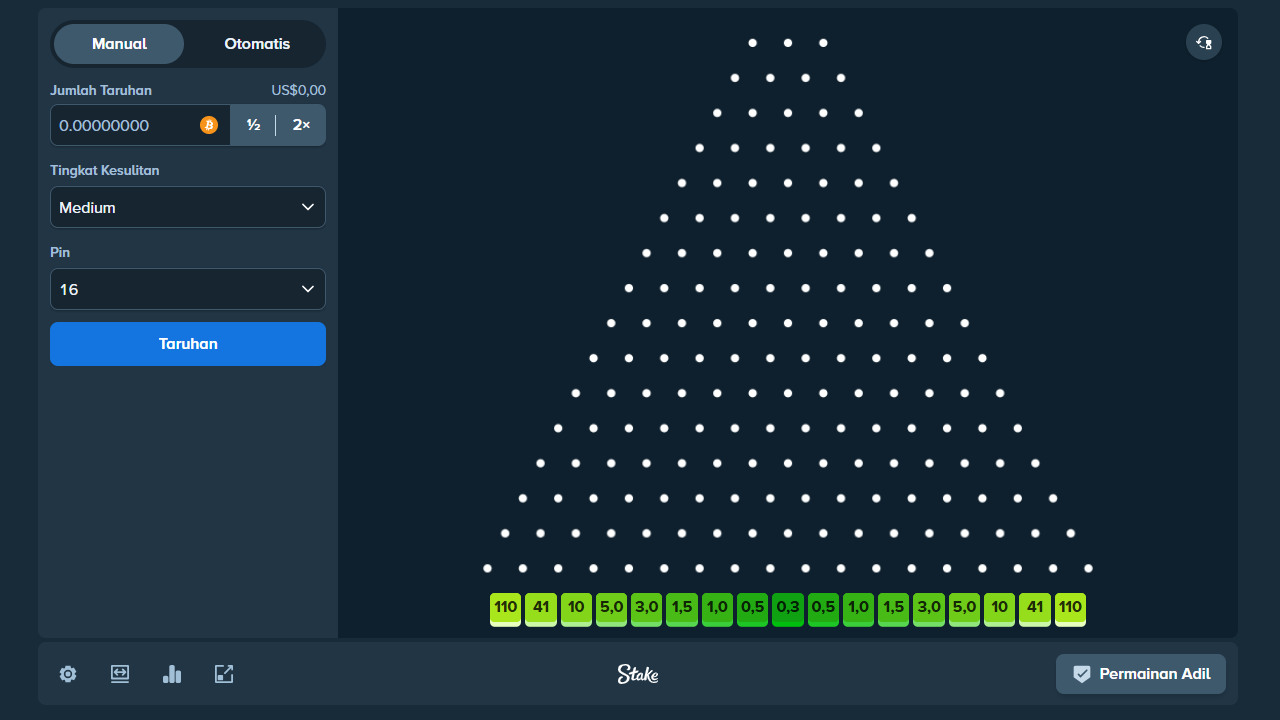
Plinko is a straightforward online game where a ball drops from the top of a triangular board, hits a series of pins on the way down and eventually lands in one of several multiplier slots. There are no paylines to study, no dealer decisions and no bonus round. One session is over in seconds.
Yet that simplicity hides a surprising amount of choice.
Online Plinko lets players change the number of rows, adjust the risk level and decide whether they want modest multipliers appearing more often or much bigger numbers on the edges of the board. Stakes Plinko version now offers four risk settings, between 8 and 16 rows, a 99% RTP and a 1% house edge. The highest Expert configuration can reach a 10,000x multiplier.
That combination has made Plinko one of the most recognizable Stake Originals and one of the games that immediately adopted crypto. It’s quick, transparent about what the player is trying to hit and fits into a provably fair system used across the Originals.
It has also become very good streaming material. A ball slowly drifting toward one side of the board can turn an otherwise uneventful casino session into a clip shared with millions of people.
The Best Casino to Play Plinko
An online Plinko game only needs simple rules and quick rounds. Stake Plinko does that particularly well.
Before dropping anything, the player chooses the wager, the number of rows and a risk level. From there, the game handles the rest. More importantly, changing those settings actually changes the game and can affect the outcomes.
The available risk levels are Easy, Medium, Hard and Expert. The higher the setting, the more aggressive the multiplier distribution becomes. Central landing positions become less attractive while the rare spots toward the edges become much more valuable.
Rows work in a similar way. Stake.com currently allows between eight and 16 rows. Increasing the number of rows gives the ball more left or right movements on its journey down the board and a wider spread of possible landing points.
For example, an eight row game on Easy has a maximum multiplier of 5.6x. Move all the way to 16 rows on Expert and the multiplier rises to 10,000x. Between those extremes are plenty of combinations, from Medium settings in the middle to Hard and Expert configurations with much bigger payouts.
Clearly, settings are important. Someone playing Plinko casually with a small balance may want a completely different board from somebody deliberately chasing a huge multiplier. Neither setting makes the odds suddenly favorable to the player. It simply changes possible wins and losses.
How Online Plinko Actually Works
Visually, Plinko may look a bit confusing in the beginning. The ball appears to hit one pin, bounce sideways, change direction again and somehow find its way to a multiplier at the bottom. The mechanics are actually quite simple.
At each level, the ball effectively has another left or right movement. With only a few rows, there are relatively few possible combinations. Add more rows and the number of possible routes increases. You’ll notice that many more routes lead toward the middle than toward the extreme edges with massive multipliers.
The Best Online Plinko Game Gives You Control Over Volatility
The fact is that players can’t control where the ball would land, so there’s no real strategy once the ball drops, since there’s no button that pushes it left, no timing trick and no secret position on the board that improves the result.
The strategy happens before the game starts.
Choosing Easy instead of Expert is a strategy decision. So is choosing 10 rows rather than 16. Bet size is also a key factor, particularly because highly volatile settings can go through long stretches without producing one of the multipliers needed to offset previous losses.
The best way to play Plinko is to decide what kind of volatility is acceptable for you before playing. Easy configurations keep the numbers relatively small. The giant multiplier disappears, but so do some of the harshest low paying outcomes.
Medium settings give players more options. Hard pushes much more value toward the outer slots. Expert mode is the riskiest. With 16 rows, the maximum jumps to 10,000x, but a player choosing that board should expect long stretches where nothing happens. Stake specifically warns that its higher volatility settings can produce longer losing streaks. That trade off is the whole appeal of the game.
More Rows Do Not Mean Better Odds
One common mistake is seeing 16 rows and assuming that more rows somehow make the game better, or more profitable.
More rows only change how the results are spread across the board. With additional rows, there are more movements before the final landing position and more potential multiplier slots at the bottom. That gives the developer room to create more payout options.
The high numbers can skyrocket. But the ball also has to travel much farther away from the center to reach them. This is why choosing the maximum number of rows only because the largest multiplier appears there is not much of a strategy. It’s simply choosing greater volatility. Many players prefer that style, but it helps to know what’s being traded for the larger number on the edge.
Plinko Strategy Starts with Bet Size
Plinko moves quickly enough that bet size can become more important than almost anything else. Dropping one ball doesn’t feel like much. Neither do five. Once Autobet gets involved, however, dozens or hundreds of rounds can disappear quickly.
Making aggressive or impulsive bets could clean your account in minutes. A player might start with $1 bets, miss the outside multipliers and decide to try $2. Then $5. Then $10 because the previous run “must” eventually turn around. Nothing about the next drop knows what happened on the previous one.
A better way is to decide how many balls will be played and how much can be spent before starting. Stake itself recommends setting a fixed ball count when using Autobet rather than simply allowing play to continue indefinitely.
Keeping the same bet size from one drop to the next makes it much easier to see what each multiplier is actually doing to your balance. If every ball costs the same amount, a 10x multiplier always has the same meaning. Constantly changing the stake turns the session into something much harder to track and can make a big multiplier disappointing if it appears immediately after the bet was reduced.
Do Not Chase the Edge of the Board
After watching hundreds of drops, it’s easy to start inventing patterns. The ball hasn’t reached the left edge recently. The right side looks “cold.” A 1,000x hasn’t appeared for thousands of balls. Perhaps changing the seed will make the big one arrive.
None of those makes the next ball more likely to hit the desired slot.
Long droughts are part of the game with random outcomes, particularly when the player is waiting for an event with a very low probability. A rare multiplier doesn’t become increasingly likely simply because it hasn’t appeared for a while.
Provably Fair Gaming Is Easy to Understand with Plinko
Plinko is one of Stake's provably fair Originals. Provably fair doesn’t mean that every bet is profitable or that the casino has no edge. Stake Plinko still lists a 1% house advantage.
The idea is about verification. Stake's system generates results using inputs that include a server seed, client seed, nonce and cursor. The system then turns those inputs into verifiable random data. After the relevant seed information is revealed, the player can independently check how a result was created.
This might sound complicated to people who are not familiar with cryptos and blockchain. Think of it as if the casino would pick a random outcome before the bet and later give the player enough information to check that the result was not secretly changed after the wager had already been placed.
Where to Play Plinko Online
Plinko has become a large casino category, so plenty of developers now offer their own versions of the game. Stake Originals Plinko is different because it was developed in house and remains exclusive to Stake. The game is also closely tied to Stake Originals.
Someone who likes the adjustable risk of Plinko can find similar games on the same platform. Dice lets the player change the relationship between probability and payout. Limbo lets the player choose a target multiplier. Mines allows the number of mines to be changed before the board is opened. All games are based on risk and reward.
Trainwrecks Took Plinko Even Further in 2026
In May 2026, TrainwrecksTV hit another remarkable Plinko result, this time playing Plinko Xtreme by Degen Lab, an Only on Stake release. A $100 wager landed the game's maximum 50,000x multiplier. The result: $5 million.
Plinko Xtreme takes the basic idea, adds more aggressive volatility and a maximum multiplier far above the standard Originals version. Plinko Xtreme and Stake Originals Plinko are separate games. The original currently tops out at 10,000x in its highest Expert configuration, while Plinko Xtreme offers a 50,000x.
Big Streamer Wins Are Entertaining, Not a Strategy
Watching somebody land a seven figure Plinko result can make the game look wonderfully easy. Drop ball. Hit the edge. Become a millionaire.
The thousands of less interesting drops surrounding those clips are much easier to forget. That’s especially important with streamers because their bankrolls, bet sizes and playing conditions can be completely different from those of an ordinary casino player. A $2,000 ball might create a spectacular 1,000x clip, but it also means risking $2,000 every time the button is pressed.
A better lesson from watching high stakes Plinko is simply how volatility works. The largest wins sit on the outside precisely because they are difficult to land, and a player chasing them has to accept all the ordinary results that come before them.
Playing Plinko Games Online for Free at Stake
Free play is perfect for Plinko because so much of the game is about understanding settings rather than learning complicated rules.
A few practice rounds can show the difference between eight and 16 rows far more clearly than reading about it.
Try Easy and the multiplier range looks relatively small. Switch to Expert and suddenly the board looks completely different. The attractive numbers become enormous, but the less attractive landing spots also become much more important.
So, demo mode is a good way to understand what the controls actually do. It can also help players see that the animation doesn’t create a skill element. There’s nothing to time once the ball has dropped and no point on the screen that can be clicked to alter its direction. The decisions are made beforehand.
Why Plinko Became a Crypto Casino Favorite
Crypto casino games tend to work best when the rules are short and simple. Dice is essentially a probability choice. Limbo is a target multiplier. Mines is about deciding how much risk to leave on a hidden board. Plinko turns the same basic idea into a falling ball.
That simplicity leaves less room for confusion. The multiplier is visible. The house edge is published. The risk setting can be changed. The game result can be checked through the provably fair system.
Stake currently lists Plinko at 99% RTP and a 1% house edge. That doesn’t make it beatable over the long run but rather makes the trade off clear.
The Best Plinko Strategy Is Simple
There’s no magic sequence of rows that forces the ball toward 10,000x. There’s no ideal moment to raise a wager because five poor results appeared in a row. And a long run without an edge multiplier doesn’t create a debt that randomness eventually has to repay.
The decisions that might affect the outcome are less complicated. Choose a risk level you understand. Keep individual bets small relative to the session budget. Decide how many balls will be dropped before Autobet begins. Do not increase the stake simply because the previous results were disappointing.
Most importantly, pick the board because its volatility suits the way you want to play, not because the largest number at the bottom looks tempting. That may not produce a dramatic strategy chart, but Plinko was never really a game about outsmarting the pins. It’s a game about choosing how much risk you’re comfortable watching on the way down.


