
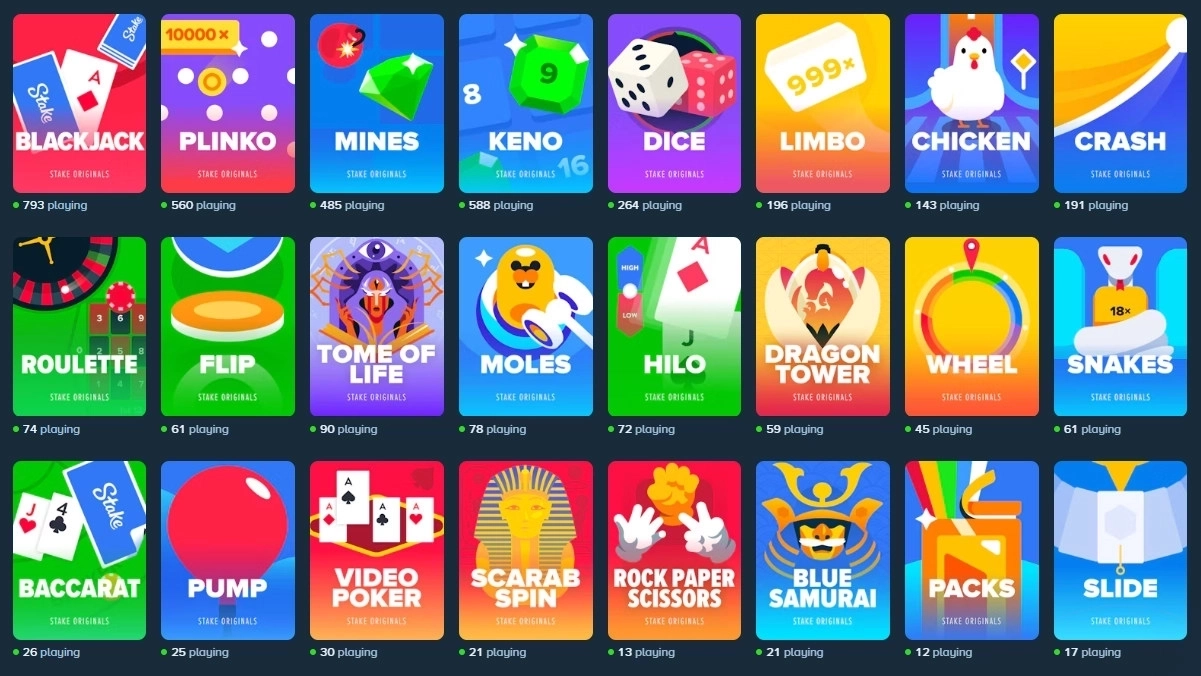
Casino games don’t always need reels, matching symbols or a bonus round. Sometimes, a number, a slider and a button are all it takes.
That’s the setup behind many casino originals. Players choose what needs to happen for their bet to win, see the possible payout and get a result a moment later. There’s usually very little to learn.
Dice, mines, wheels and multiplier games are fixtures in many online casinos. They look different but often work in the same way with short rounds, straightforward rules and a clearly displayed house edge.
What Makes a Casino Game an Original?
Casino originals are games made in-house by the operator. Instead of adding a title from an outside slot studio, the casino develops its own game, with its own rules, controls and payouts. They’re the casino’s own games.
For instance, Dice and wheels have been around for a long time. What belongs to the operator is a specific version. Stake Dice, for example, was developed in-house by Stake.
A third-party slot works differently. A separate studio makes the game and supplies it to casinos.
Original Casino Games vs Slots
With a slot, players are usually watching symbols land and check whether they form a winning combination. There might be paylines, ways to win or clusters, plus wilds and scatters with their own jobs.
A simple original gives you less to keep track of. A number needs to fall below your target. A multiplier needs to reach a certain level. A wheel needs to land on a paying segment. The whole betting process could fit in one sentence.
There are no reels or paylines in these particular formats, and usually no separate bonus feature to learn. Once the result appears, you can see whether it meets the winning condition.
That’s best for players who prefer to know exactly what they’re waiting for. Slots offer something different, with themes, animations and features that can change what happens during a spin. It comes down to which kind of game you like. Instant win casino games keep the round short and the rules simple. Slots can give you more features to follow. Either way, the payout rules still determine the odds.
Sometimes One Click Is the Whole Game
In many originals, you set the bet, press the button and get the result. That’s the round finished. There’s no wait for three scatters, no free spin counter and no extra purchase to open a feature. Your bet is settled.
An animation might make the number climb or the wheel turn, but you usually don’t need to do anything while it runs. Once it ends, you can change the settings, repeat the bet or stop.
Some originals take a little longer. Mine games let you make several picks, and crash games can let you choose when to cash out. So, instant format means that many games get straight to the point, without several extra stages between the bet and the payout.
Multiplier Games Start with a Target
A multiplier tells you how much a winning bet pays compared with your stake. A 3x total payout means you receive three times the amount you bet.
Suppose you stake $2 and win at 3x. You receive $6 altogether. Because $2 was your own stake, the profit is $4. Unless the rules say otherwise, the displayed multiplier usually includes the amount you put in.
In target based multiplier games, you choose the payout you’re aiming for before betting. A low target is reached more often, with a smaller return when you win. Raise the target and the possible payout grows. Other versions use a rising multiplier and a cash-out button. You have to take a payout before the round ends, which adds a different decision.
Dice Games Let You Move the Winning Line
Online dice usually swaps the familiar cubes for a numbered scale. The idea is to pick a number, then bet on a result above or below it.
Choose a wider winning range and more results will win, but each win pays less. Narrow that range and the possible payout gets bigger because there are fewer numbers that can win. Stake Dice puts the target, win chance and multiplier together on screen. Change one and the others adjust so they all show the same bet.
Before placing a bet, check whether the result needs to be above or below your target, and whether landing exactly on that number counts as a win. Moving the slider changes your chances of winning, but it won’t tell you what’s coming next. A few high or low rolls don’t mean the next one suddenly has to go the other way.
Mine Games Let You Pick or Cash Out
Mine games put covered tiles in front of you. Some hide safe results; others hide mines that end the round. You choose the number of mines before betting. Then you reveal tiles one at a time. Each safe pick increases the amount available to cash out. You can collect it or risk another pick for a larger payout.
Stake Mines uses a 25 tile board with this setup. Hit a mine and you lose the wager; reveal a safe tile and you get another chance to continue or cash out.
More mines mean fewer safe tiles. Revealing more tiles also makes completing your planned run harder. The decision is whether the next possible increase is worth risking the amount already available. That can make a round last longer than a single dice roll.
Wheel Games Show the Payouts Before the Spin
A wheel original game puts its possible payouts around a circle. You place a bet, the wheel spins and the selected segment decides the return.
Some versions offer risk settings or different segment counts. Stake Wheel lets you adjust both, with multipliers shown.
The largest multiplier is easy to notice, but the smaller values deserve a look too. Some segments may return less than you bet, while others pay nothing. Getting money back doesn’t always mean you made a profit. If you bet $2 and a segment returns $1, you’ve still lost $1 on that round. Check what each result pays before spinning. Once you understand the values, reading the outcome is simple.
Casino Games RTP
RTP means return to player. It tells you how much of the total money wagered a game is designed to pay back over a very large number of rounds.
House edge is the remaining share. A game with 99% RTP has a 1% house edge. At 90% RTP, the house edge is 10%.
Those figures describe the average the game is designed around. They don’t promise that any amount of play will produce those exact totals. Actual returns can vary, with bigger swings possible over shorter stretches.
A 99% RTP also doesn’t mean 99 out of every 100 bets win. How often a bet wins is a separate figure.
Your Deposit Isn’t Your Total Wagered
The house edge applies to the money you bet, including any money you bet again after a payout. Say you deposit $20. You place several bets, receive some returns and use that money for more rounds. By the time you stop, you could have wagered much more than your original $20. That’s why a small percentage shouldn’t be read as a fixed fee taken from your deposit. A 1% house edge doesn’t mean a $20 session will cost exactly 20 cents.
You might finish ahead, lose part of the deposit or lose all of it. The theoretical percentage describes the long run average across wagers, rather than setting a limit on what one player can lose.
Why Do Originals Often Have Higher RTP?
Many familiar instant win originals publish RTP figures around 98% or 99%. Online slots commonly sit around 94-97%, although there are titles above and below that range.
The higher return is a design choice. For in-house casino games, the operator sets the payout structure and can offer a smaller house edge.
There’s nothing about a number game that automatically forces it to return more. Simple games can have poor odds, and slots can have comparatively high returns. You still need the percentage for each game.
The figures are often easier to spot on originals because the games have fewer rules.
Slots are designed by their providers. Some providers supply more than one RTP version, and the casino chooses which version to offer. Check the information inside the game you’re actually playing, because a figure listed elsewhere may belong to another version.
What Does Provably Fair Mean?
Many originals are provably fair games, so there’s a way to check how a past result was produced.
Before play starts, the casino shares a hash of its server seed. Think of it as a digital fingerprint. The seed stays hidden for now, but the fingerprint lets you check later that the casino used the same one. Each result comes from that server seed, a client seed you can choose or change, and a number called a nonce. The nonce goes up with every bet, allowing the same pair of seeds to produce different results.
After you rotate the seeds, the old server seed is revealed. You can then check that its fingerprint matches the hash shared before play and use the published calculation to verify your results. If the casino replaced the server seed afterwards, the fingerprint wouldn’t match.
There’s no need to know how to code to understand the idea. The casino commits to a seed before the bets, then reveals it so those bets can be checked.
Verification Doesn’t Predict the Next Win
The seeds and hash are there to help you check results after play. They don’t give you a preview of the next round. Choosing your own client seed doesn’t let you choose a winning number. It adds a player controlled input to the process.
Provably fair and high RTP also mean different things. One tells you about checking the result; the other tells you about the game’s theoretical return. A game can follow its published process and still favor the house. That’s how a verifiable result and a house edge can exist together.
Verifying a round answers a question about that outcome. Questions about withdrawals, account rules and customer support need their own answers. A fairness badge cannot tell you everything about a casino.
A High Return Doesn’t Mean Frequent Wins
Two bets can have the same RTP and produce very different runs of results. One might pay small amounts often. Another might lose repeatedly before paying a much larger amount. Both are based on a similar long term return.
Volatility describes those differences in how payouts are spread out. When you choose a setting with larger payouts, you should expect more losing rounds.
A lower target may bring more wins, but each win adds less. A higher target offers more when it hits, with a greater chance that your bet returns nothing. Neither setting makes the next result predictable. A losing run doesn’t build up a debt that the game has to repay to you.
Read RTP alongside the win chance and payout, where those are available. Each tells you something the other figures leave out.
Are Originals Always Crypto Casino Games?
You’ll often find originals on sites offering crypto casino games, but the payment method doesn’t define the game. “Original” tells you the operator makes it in-house. “Crypto” refers to the currency used. “Provably fair” refers to a way of checking results. Those descriptions can all apply to one title, but they aren’t interchangeable.
Some casinos offer their originals with both cryptocurrencies and local currencies, like Stake. However, using Bitcoin doesn’t instantly improve the odds or make a game verifiable. The game’s rules and fairness system determine those things.
Seed based verification also doesn’t require every round to be recorded as a separate blockchain transaction. To understand what you’re playing, look at how the game works as well as how you pay.
Limbo Shows How It Works
Limbo brings several of these ideas together. You choose a stake and target multiplier, then the game generates a result. Reach or exceed your target and the bet wins at the payout you selected. Fall short and you lose the stake. At a 2x target, the win chance is 49.5%.
The published return is 99% RTP, with a 1% house edge. A higher target offers a larger payout but wins less often. There are no reels, paylines or bonus rounds to follow, and the result can be verified through the fairness system. You can see that setup on the Limbo game page and play Limbo online, where the rules, multipliers and payout options are clearly displayed. If you decide to play, choose an amount and time limit you’re comfortable with before starting, and stop when you reach them.


